
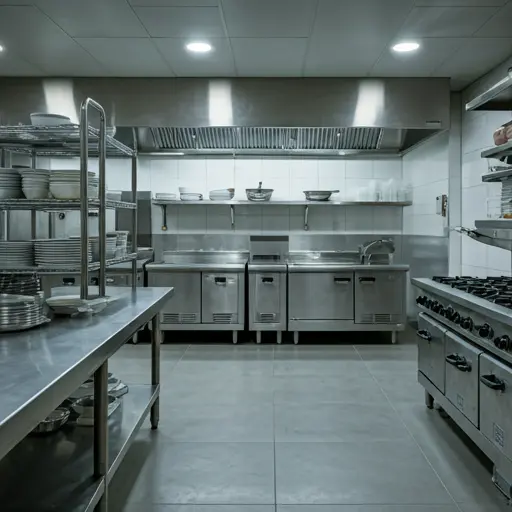
Pest Control for Restaurants and Food Businesses in Kerala
For any food business, a pest sighting is not just a hygiene problem — it is an immediate threat to your FSSAI licence, your reputation, and your revenue. A cockroach in the kitchen or a rat near food storage can trigger a closure order from the Food Safety and Standards Authority of India (FSSAI) on the same day it is reported. And in the age of social media, a photograph of a pest in a restaurant reaches thousands of people within hours.
Kerala Pest Solutions provides professional, FSSAI-compliant pest management for restaurants, hotel kitchens, canteens, bakeries, food processing units, and catering operations across Trivandrum and Kollam. Our methods are specifically selected for food environments — no strong-odour sprays, no kitchen downtime, and full documentation for every visit.
Regulatory Environment
The Stakes Are Higher
for Food Businesses
FSSAI’s Food Safety and Standards (Licensing and Registration) Regulations require all food businesses to maintain documented pest control programmes as part of their Good Manufacturing Practice (GMP) compliance. During a scheduled or surprise audit, inspectors check for evidence of pest activity, physical proofing measures, and pest control service records. Any evidence of active infestation is categorised as a critical non-compliance — the highest severity level — and can result in immediate suspension of the licence. Beyond compliance, the reputational damage from a pest incident in a food business can be permanent. Kerala Pest Solutions understands this and structures our restaurant pest control service around documentation, discretion, and guaranteed response times.
Audit-Ready 24/7
Our documentation meets the strictest health department inspections in Kerala.
Zero Tolerance
Proactive elimination of nests before they become visible infestations.
Targeted Solutions
Specialized treatment protocols for high-risk kitchen pests.
Cockroaches
The most common and most dangerous pest in food preparation environments. German cockroaches breed rapidly in warm kitchen environments and are vectors for Salmonella, E. coli, and other pathogens. They contaminate food surfaces, equipment, and packaging simply by moving across them. Our treatment uses odourless gel bait applied to harborage sites — no sprays, no kitchen shutdown, no chemical odour.
Flies
Flies in food preparation areas are both an FSSAI compliance issue and a direct contamination risk. Kerala's climate makes fly pressure year-round, with a peak during and after the monsoon season. We recommend UV fly traps for active food preparation areas combined with external barrier treatment around waste and drainage areas.
Ants
Ants in food storage areas contaminate dry goods and are a common trigger for customer complaints. Our non-repellent gel bait eliminates the colony rather than redirecting it to another area of the restaurant.
Rodents
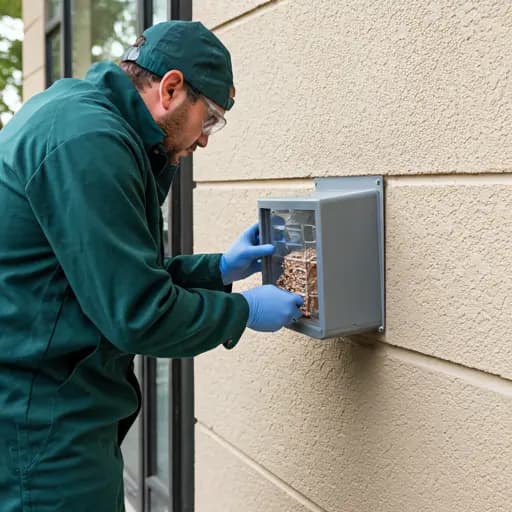
Rats and mice in a food business contaminate stock, gnaw through packaging, and carry diseases including leptospirosis and salmonellosis. They are also a leading cause of unexplained electrical fires through cable gnawing. FSSAI inspectors treat any evidence of rodent activity as a critical finding. Our commercial rodent programme deploys tamper-resistant bait stations in back-of-house areas, storage rooms, and external perimeter zones, monitored fortnightly and documented in a service log.
Our Restaurant Pest
Control Programme
Initial Site Survey and Risk Assessment
Every new restaurant client begins with a structured site survey. We inspect all kitchen areas, food storage zones, waste management areas, drainage, and the building perimeter. We identify pest species present, assess the infestation severity, and produce a written risk report with priority-rated recommendations for both treatment and physical proofing.
Scheduled Treatment Visits
We recommend monthly treatment visits for active food businesses in Kerala. Monthly visits allow us to respond quickly to any new activity and ensure that the chemical barriers and bait stations are maintained at effective levels. For businesses in food courts or areas with high adjacent pest pressure, fortnightly visits may be recommended.
Service Documentation
Every visit is documented in a pest control service logbook maintained at your premises. The logbook includes the date and time of each visit, the technician name, the pests targeted, the products applied, the application zones, and the findings for that visit. This is the document that an FSSAI inspector will ask to see. It should be available on-site at all times.
Corrective Action Reports
If any evidence of pest activity is found during a scheduled visit, we issue a Corrective Action Report (CAR) identifying the activity, the likely cause, the immediate treatment applied, and the recommended structural or sanitation actions required to prevent recurrence. CARs are part of your compliance documentation.
How We Work
Without Disrupting
Your Business
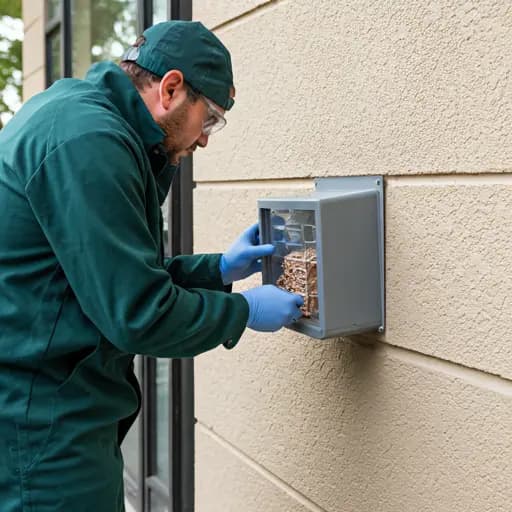
We understand that your kitchen never truly sleeps. Our operations are designed for invisibility.
After-Hours Execution
Treatments scheduled during prep-breaks or post-closing to ensure zero interference with service.
Discrete Technicians
Our team operates with high professionalism, ensuring no public-facing disruption.
Non-Toxic Focus
Heavy focus on baits and physical barriers rather than broad-spectrum spraying in food zones.

FSSAI Compliance Checklist
Essential technical documentation provided for continuous operational security.
Active Service Contract
Verified Regulatory Asset
Pest Control Logbook
Detailed Activity Records
Bait Station Map
Infrastructure Layout
CARS (Corrective Action Reports)
Structural Integrity Book
Chemical MSDS Sheets
Material Safety Data
Structural Proofing Proof
Ingress Defense Records